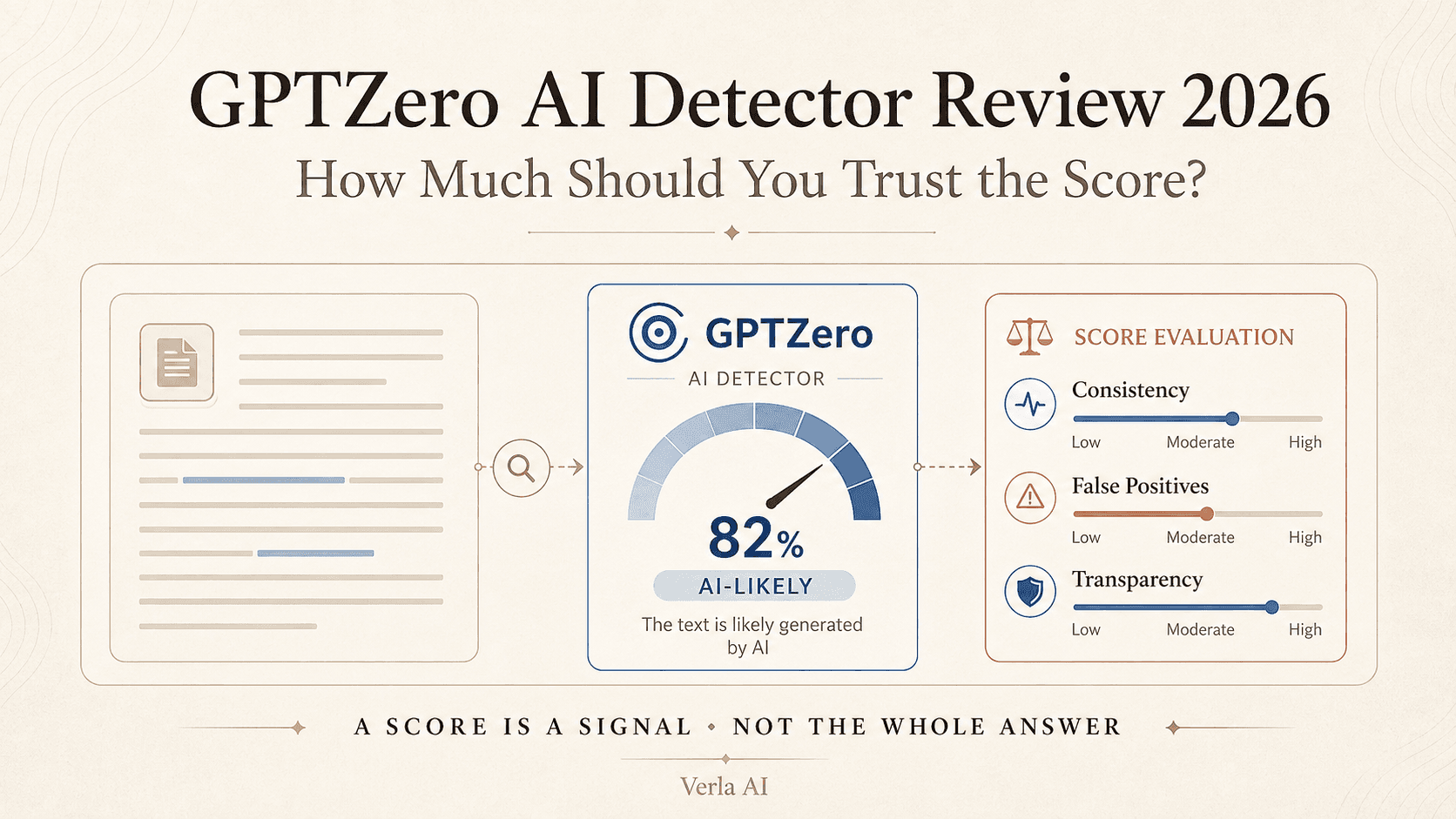
A random AI Detector says your essay is 83% AI.
Annoying.
GPTZero, one of the best-known AI Detector tools, says your essay is 83% AI.
Now you are rereading every sentence.
That is the power of a trusted detector—and the reason this review matters. We looked at GPTZero's pricing, accuracy, limitations, and what that percentage actually tells you before deciding whether it is worth paying for.
What Is GPTZero, and What Do You Actually Get?
GPTZero started with a simple job: paste in some text and ask whether it looks AI-generated.
It has become a much larger product.
A scan now gives you a document-level result plus sentence-level analysis, with classifications for human, AI, and mixed writing. GPTZero also offers Advanced Scan, plagiarism checking, writing feedback, citation checks, Chrome and Google Docs tools, and Writing Replay, which can show how a document was produced over time.
That last feature is more important than it sounds.
If a professor questions an essay, another percentage is not always the best response. A visible writing history—drafting, deleting, revising, returning to earlier paragraphs—can tell a much richer story than “GPTZero says 7%.”
GPTZero seems to understand this.
Its educator tools increasingly move beyond trying to answer “AI or human?” and toward showing the process behind the document.
Still, most students do not come to GPTZero for a writing replay.
They come for the number.
Paste.
Scan.
Wait a few seconds.
How much AI is in my essay?
That number is where GPTZero becomes useful.
It is also where people start asking it to do more than an AI Detector can really do.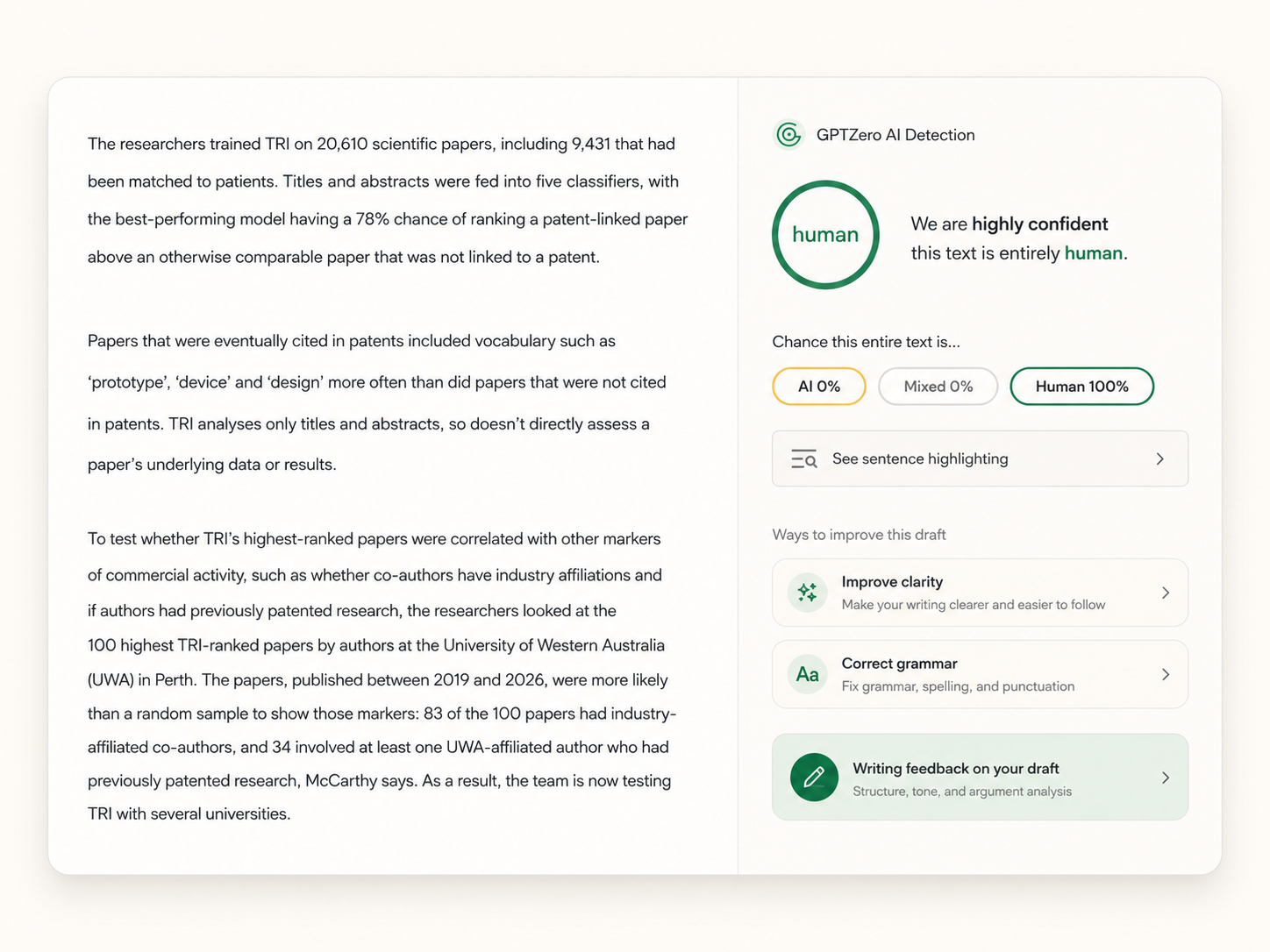
GPTZero Pricing: Is the Free Plan Enough?
For most students, start free.
Not “start free so you can see the interface.”
Start free because you may never need to pay.
GPTZero currently gives students 10,000 words of scanning per month without a credit card. The free plan also includes AI detection, multilingual detection, writing feedback, and access to its Chrome extension.
Ten thousand words is not a tiny demo.
If your essays are around 1,500 words each, that is enough to check six of them in a month and still have some room left.
For someone scanning coursework before submission, that can genuinely be enough.
Paid plans make more sense when GPTZero becomes something you use constantly rather than occasionally.
The current annual prices start at $8.33/month for Essential, with 150,000 words per month. Premium is $12.99/month for 300,000 words, while Professional is $24.99/month for 500,000 words. Paying month to month raises those prices to $14.99, $23.99, and $45.99 respectively.
Those are enormous jumps in volume.
Which creates a slightly strange buying decision.
A student who scans four essays probably does not need 150,000 words.
A teacher scanning four classes might.
That is why I would not think about GPTZero Premium as “the version where the detector finally becomes good.”
The free detector is already the product.
Paid GPTZero is really about more volume and more workflow around the result—larger scans, plagiarism features, reports, batch processing, and the other tools that become useful when checking writing is part of your routine.
There is also no reason to upgrade simply because one essay came back with an uncomfortable number.
Paying GPTZero does not make an 83% score become more true.
It just lets you scan more.
So if you are an individual student, the purchasing advice is unusually easy:
Use the free plan until the free plan becomes annoying.
Then upgrade.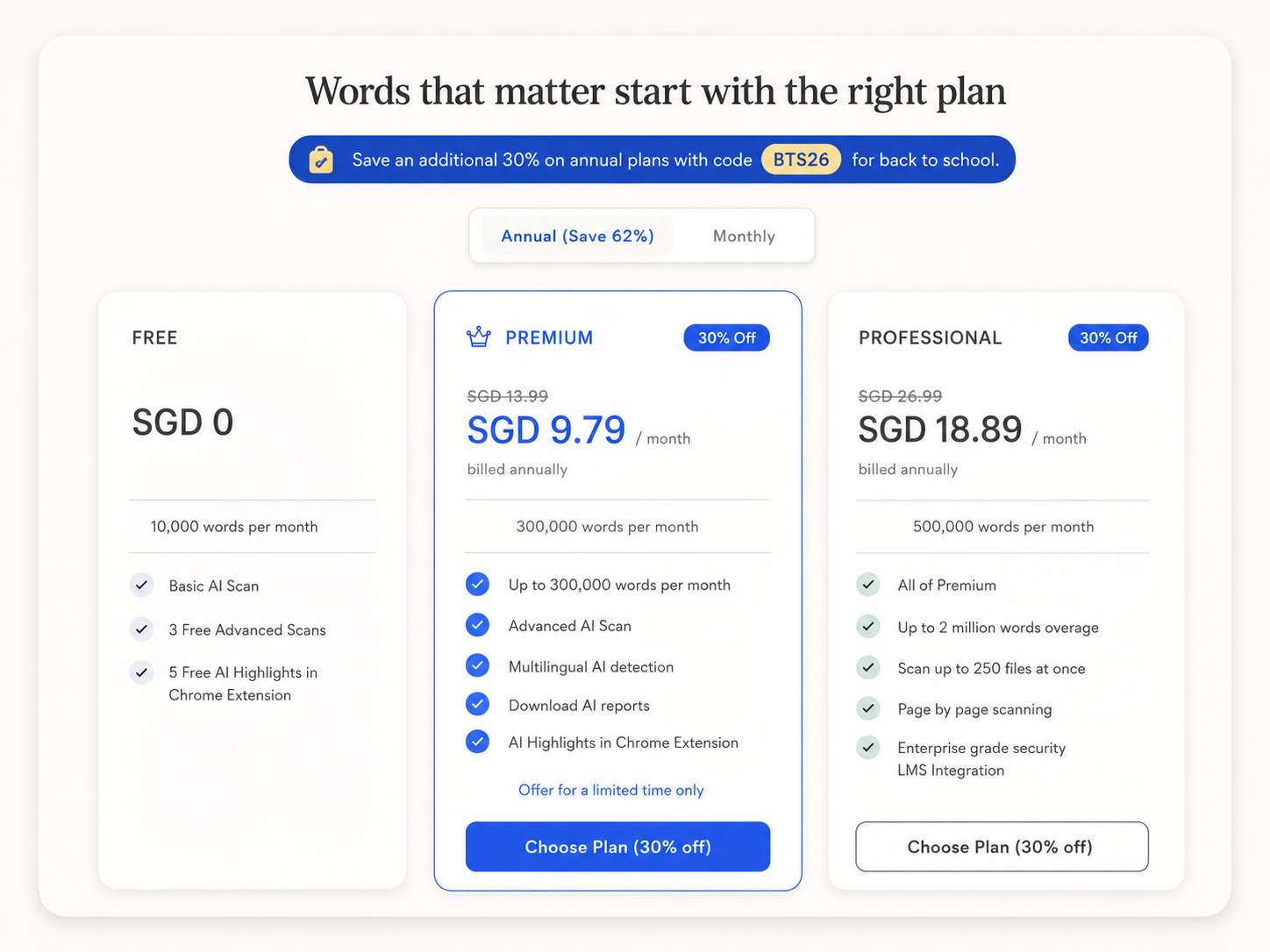
How Accurate Is GPTZero — and How Much Should You Trust the Score?
Here is the part where most GPTZero reviews become less useful.
Some competitor runs a ChatGPT paragraph through GPTZero.
It gets detected.
Then they run the same paragraph through their own Humanizer.
GPTZero misses it.
And somehow this becomes proof that GPTZero is either brilliant or useless.
That is not a serious test.
GPTZero deserves a harder question because there is actually good evidence that the detector performs well.
In its February 2026 standardized benchmark, GPTZero reported 99.76% overall accuracy, 99.60% recall, and a 0.08% false-positive rate across four domains using its then-current model. GPTZero also publishes details of its benchmark construction and says it updates these evaluations quarterly.
Those numbers are excellent.
GPTZero's broader technical documentation reports a false-positive rate below 1%, 96.5% accuracy on mixed human-and-AI documents, and lower error rates for results marked with high confidence.
So we do not need to pretend GPTZero is a bad AI Detector to make this review interesting.
It isn't.
The more interesting part is what 99% accurate actually means.
Because these two sentences can both be true:
GPTZero can be 99% accurate on a benchmark.
GPTZero can be wrong about your essay.
There is no contradiction there.
A benchmark asks what happens across a large collection of known human and AI texts under defined conditions.
You are asking something much smaller and much more personal:
GPTZero just gave my paper 73% AI. Did I use AI?
The benchmark does not know.
It cannot.
An AI Detector sees text.
It does not see you writing at 1:13 a.m.
It does not know that you rewrote the introduction five times.
It does not know that English is your second language.
It does not know whether ChatGPT wrote the entire paragraph, fixed two awkward sentences, suggested a transition, or was never opened at all.
It sees patterns.
Then it estimates.
That distinction becomes particularly important once writing sits somewhere between “entirely human” and “entirely generated.”
A 2025 academic study tested GPTZero on 28 AI-generated essays and 50 human-written essays. Most AI essays were identified successfully, but several human essays produced false positives. The researchers concluded that GPTZero could be effective at recognizing clearly AI-generated writing while still requiring caution when used to judge human-authored work.
More recent research points at an even messier problem: AI-assisted writing is not binary.
A 2026 study of academic abstracts found that detectors including GPTZero could flag writing that had received relatively light AI editing, while some unmodified contemporary human writing also received AI flags. The authors argued that detector scores should not be treated as standalone evidence of academic misconduct because the detector cannot tell the difference between every form of AI assistance and full AI authorship.
This matters much more than whether GPTZero catches a fresh ChatGPT essay.
Fresh ChatGPT output is the easy case.
Real student writing is messy.
A paragraph may begin with your own notes, get reorganized by Claude, be shortened by you, have two sentences polished by Grammarly, then sit beside three paragraphs written entirely from scratch.
What percentage is that?
More importantly:
What is the percentage supposed to prove?
GPTZero itself gives a surprisingly sensible answer.
Its technology page says no AI Detector is 100% accurate and explicitly recommends using detection as a conversation starter rather than a final verdict. Its educator guidance tells teachers who see a suspicious result to look at edit history, ask the student about their process, and check patterns across multiple assignments rather than relying on one scan.
That may be the most useful thing GPTZero says anywhere on its website.
Not “99% accurate.”
Not “#1 AI Detector.”
This:
Look for more evidence.
Because a strong detector can tell you where something looks unusual.
It cannot reconstruct what happened.
There is another subtle point worth noticing.
GPTZero provides sentence-level highlighting and confidence categories for a reason. A 67% document score by itself is blunt. Seeing that two paragraphs carry most of the AI signal is much more actionable. GPTZero says its highest-confidence classifications have an average error rate below 1%, while lower-confidence results naturally deserve more caution.
So if you use GPTZero on your own work, I would spend less time staring at the big percentage.
Look underneath it.
Which passages were flagged?
Are they generic?
Overly uniform?
Full of transitions you would never normally use?
Or are they accurate, ordinary sentences that happen to resemble patterns the model associates with AI?
That tells you what to review.
The score alone cannot tell you what to believe.
Is GPTZero Worth Paying For?
GPTZero is one of the easier AI Detectors to recommend.
The free plan is generous. The detector has credible benchmark performance. Sentence-level feedback is more useful than getting one mysterious percentage and being sent on your way.
If you are a student checking a few essays each month, I would stay free.
If you regularly hit the limit, need plagiarism checking, want larger uploads, or need writing reports and higher-volume scanning, paying starts to make sense.
But there is a point where GPTZero stops helping.
It tells you:
This paragraph looks AI-generated.
And now you have another problem.
What exactly are you supposed to do with that information?
That is where the buying decision starts moving away from “Which detector is most accurate?” and toward “Which tool helps me finish the draft?”
The Best GPTZero Alternative for Students
Imagine GPTZero gives your essay a high AI score.
You open the sentence highlights.
Three paragraphs are doing most of the damage.
Now what?
You could start changing words until the percentage falls.
That is also a very easy way to make a perfectly good essay worse.
A precise term becomes a vague synonym.
A citation stays in place while the sentence around it changes.
A clear argument gets padded with awkward phrasing because somebody told you “burstiness” looks human.
The detector problem becomes a writing problem.
That is the difference between GPTZero and Verla.
Verla AI Detection also reviews writing paragraph by paragraph, but the result is designed around the next step: locating the sections that deserve attention and giving you a clearer path into revision. Verla currently includes an overall score alongside paragraph-level signals and improvement guidance.
If a section genuinely sounds mechanical, Verla AI Humanizer lets you rewrite it paragraph by paragraph and compare the new version with the original instead of replacing the entire essay just to chase a different number.
And sometimes the paragraph is not really the problem.
Maybe the argument does not answer the prompt.
Maybe the source never supported the claim.
Maybe the conclusion drifted away from the rubric three pages ago.
Verla Assignment lets you bring the prompt, notes, source materials, datasets, and reference files into the same academic workflow, so revision can still be connected to what the assignment actually asked you to do.
That is the trade-off.
If all you want is another AI score, GPTZero is an excellent place to start—and its free plan makes it hard to argue against.
Verla makes more sense when the score is only the beginning.
The current Verla Basic plan is $7.99/month when billed annually and includes 10,000 AI Detection words, 5,000 Humanizer words, three Assignment uses, and up to five uploaded files per assignment.
That is obviously more expensive than GPTZero Free.
You are paying because it does a different job.
GPTZero answers:
“What does this text look like?”
Verla is built around the question that usually comes five seconds later:
“Okay. What should I do now?”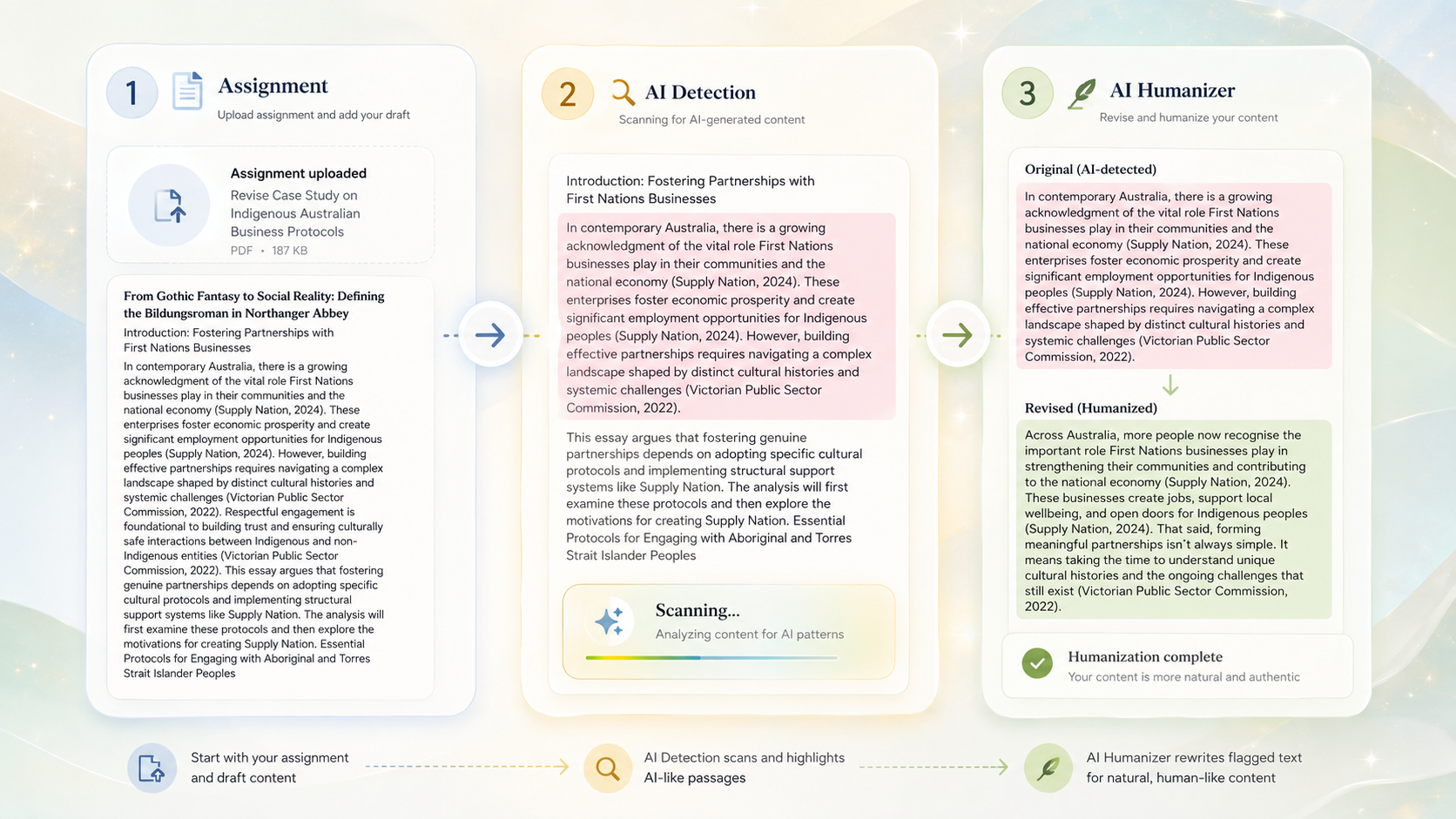
Frequently Asked Questions
Is GPTZero free?
Yes. GPTZero currently offers a free student plan with up to 10,000 words of scanning per month and access to features including AI detection and its Chrome extension. For many students checking a handful of essays each month, that allowance may be enough without upgrading.
How accurate is GPTZero?
GPTZero's February 2026 standardized benchmark reported 99.76% accuracy, 99.60% recall, and a 0.08% false-positive rate across four evaluated domains. Those are benchmark results rather than a guarantee for every individual document, and GPTZero itself says no detector is 100% accurate.
Can GPTZero falsely flag human writing as AI?
Yes. GPTZero works to keep its false-positive rate low, but false positives are still possible. Academic studies have also documented human-written essays receiving AI flags. GPTZero recommends treating detection as supporting evidence rather than a final verdict.
Can GPTZero detect ChatGPT, GPT-5, Claude, and Gemini?
GPTZero says its detector is continually updated for current models and currently lists major model families including ChatGPT/GPT models, Gemini, Claude, Llama, and others. Performance can still vary with text length, editing, language, and how much human input is mixed into the final draft.
What is the best GPTZero alternative for students?
If you only need a standalone AI Detector, GPTZero's free plan is already a strong option. If you want to move from detection into revision, Verla AI Detection identifies paragraph-level signals, Verla AI Humanizer supports targeted rewriting, and Verla Assignment keeps the work connected to your original prompt, sources, and requirements.