You open a blank document and type:
This essay will discuss how social media affects university students.
It sounds academic. It introduces the subject. It may even sit at the end of an introduction. But it is not yet a thesis statement because it does not tell the reader what the essay will say about social media.
Now compare it with this:
Frequent social media interruptions make it harder for university students to sustain attention during independent study.
The subject has not changed, but the second sentence makes a claim. It gives the paper a direction and creates something the body paragraphs can explain, examine, or support. A topic tells readers what your paper is about. A thesis statement tells them what your paper has to say about it.
In Short
A thesis statement is the central claim, interpretation, or conclusion that an essay develops. It usually appears near the end of the introduction and answers the main question behind the paper. A clear thesis does more than name the subject: it establishes the paper's direction and gives the body paragraphs a shared purpose.
What Is a Thesis Statement?
A thesis statement expresses the main point that a writer wants readers to understand, consider, or accept. Depending on the assignment, that point might be an argument, an interpretation, an explanation, or a conclusion drawn from evidence.
"Climate change," for example, is a topic. A thesis has to say something more specific about climate change:
Local governments can reduce urban heat more effectively by expanding tree cover in low-income neighborhoods than by relying on short-term cooling centers alone.
This sentence identifies the subject, takes a position, and narrows the discussion. It also creates expectations: the reader anticipates evidence about urban heat, tree cover, cooling centers, and differences between neighborhoods.
A thesis is sometimes described as a road map, but it does not always need to list every section that follows. Its more important job is to establish the idea that connects those sections. Think of it as a promise: the introduction makes the promise, and the body of the paper has to fulfil it.
When a Topic Pretends to Be a Thesis
Imagine that your assignment asks:
How has remote work affected collaboration among knowledge workers?
Your first attempt might be:
Remote work and workplace collaboration are important issues.
This names the subject, but "important" does not reveal what the paper has discovered.
This essay will examine the effects of remote work on collaboration.
Now the reader knows your intention, but not your conclusion. The question itself is not a thesis either:
Has remote work improved or weakened workplace collaboration?
A thesis answers that question:
Although remote work reduces spontaneous office interaction, it can improve collaboration among knowledge workers when teams replace informal communication with documented, asynchronous processes.
The final version gives the paper something to develop and leaves room for complexity. If you understand your topic but cannot yet turn it into a focused answer, the Thesis Statement Generator can help you explore possible claims based on the assignment question and existing ideas. Treat the results as working options that still need to match the available evidence.
What Does a Thesis Statement Do?
A thesis shapes decisions that might otherwise feel unrelated.
Suppose you are researching food delivery apps and student spending. You find articles about convenience, labor conditions, restaurant fees, nutrition, advertising, and personal finance. All relate to the general topic, but they cannot all fit into one focused paper.
Personalized discounts on food delivery apps encourage university students to make more frequent unplanned purchases, increasing total food spending even when individual orders appear inexpensive.
Once that claim is in place, evidence about discount notifications, purchasing frequency, and spending behavior becomes relevant. A thesis also helps readers understand why each paragraph is there: the paragraphs may cover different evidence, but all establish the same central idea.
A topic sentence operates at a smaller level: it introduces the point of one paragraph. The thesis governs the paper as a whole. Our guide to thesis statements vs. topic sentences explains that relationship in more detail.
Not Every Thesis Makes the Same Kind of Claim
Academic assignments ask writers to do more than argue for or against an issue.
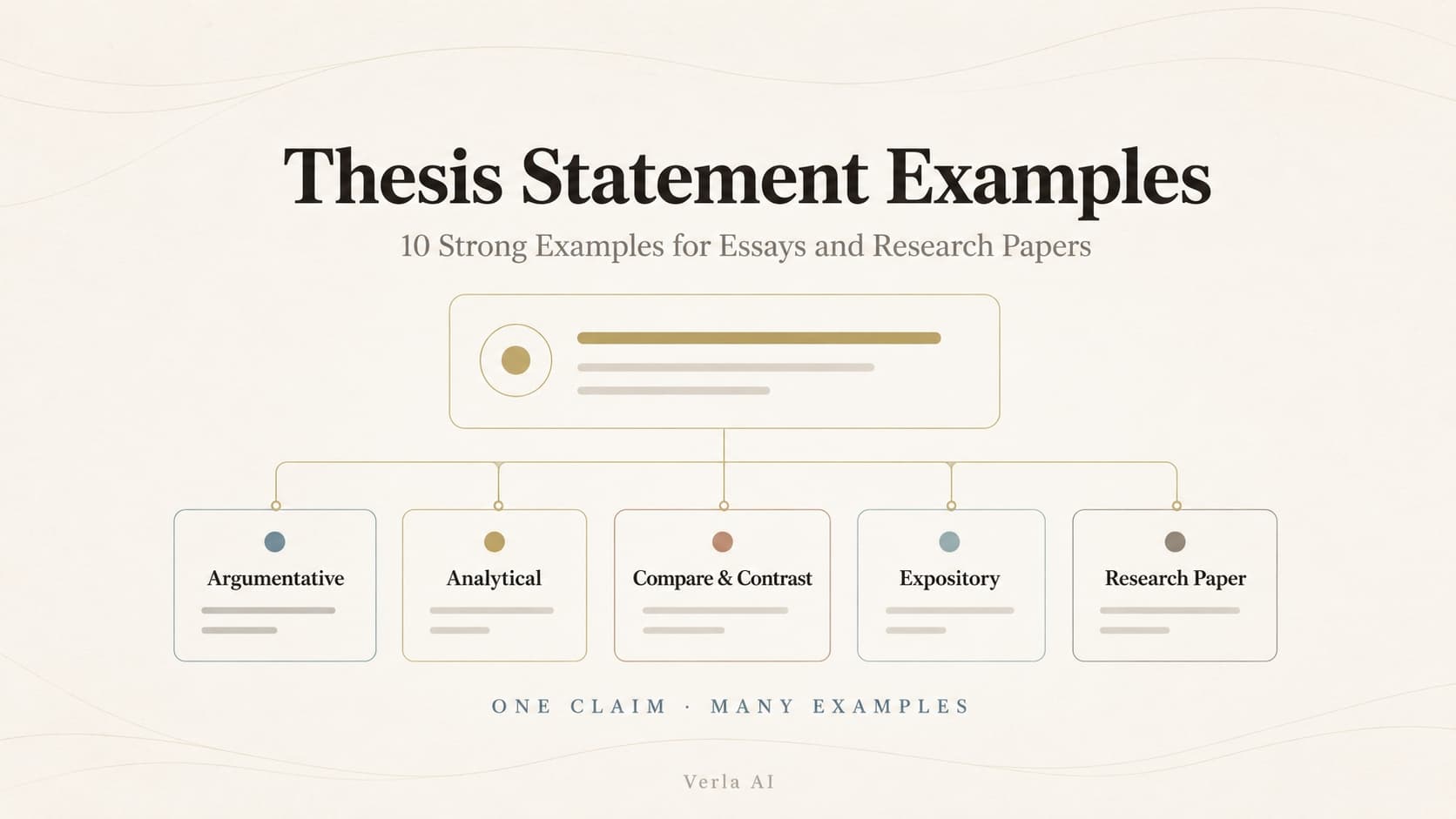
Paper type | Example thesis |
|---|---|
Argumentative | Universities should provide free public transport passes because commuting costs limit lower-income students' access to classes and campus resources. |
Analytical | By shifting between private diary entries and public speeches, the novel shows how its protagonist constructs different identities for different audiences. |
Expository | Sleep deprivation affects academic performance by reducing working memory, slowing cognitive processing, and weakening emotional regulation. |
The language of a thesis depends on the task. Words such as evaluate, compare, analyze, explain, and argue ask for different kinds of answers. See how to write a thesis statement to develop that answer, or browse these thesis statement examples for more paper types.
Where Should a Thesis Statement Go?
In most student essays, the thesis appears near the end of the introduction. The preceding sentences establish context and narrow the subject; the thesis then tells readers what the paper will establish.
This is a convention, not an unbreakable law. A longer introduction may present the thesis in its second paragraph, and some forms of writing delay the central claim for a deliberate reason. In most university assignments, however, readers should not have to search several pages to discover the paper's main point. Assignment instructions and disciplinary conventions should take priority over a universal formula.
How Long Should a Thesis Statement Be?
For most essays, one clear sentence is enough. A more complex research paper may need two sentences if the central claim and its scope cannot be expressed naturally in one.
Word count is not the best test. A twelve-word thesis can be too broad, while a forty-word thesis can be precise. The useful question is whether every part of the sentence contributes to one coherent point. Details such as every example, qualification, cause, and consequence belong in the body; the thesis should give readers the controlling idea.
Why Your Thesis May Change While You Write
A thesis often looks final because it appears in a polished introduction. In practice, it may begin as a provisional answer. Early in your research, you might expect to argue that online classes reduce student participation. After reading studies and examining course data, you may discover that participation changes form instead: students speak less during live sessions but contribute more frequently through discussion boards and collaborative documents.
If the evidence changes your understanding, the thesis should change with it. Holding on to the original sentence and ignoring contradictory evidence only creates a gap between what the introduction promises and what the paper actually shows. A working thesis gives the draft direction without preventing the writer from learning.
A thesis statement is small enough to fit into one or two sentences, but it influences almost every decision in a paper. Before treating yours as finished, ask: if a reader saw only this sentence, would they know what the paper has to say—not merely what it is about?